St Magnus Marathon, Orkney
Sunday 5th July 2026
Race Report by Ralph Williams
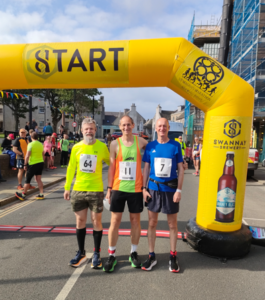
Ralph and friends on the start line
After running the most northerly UK half marathon 2 weeks ago in Shetland (Simmer Dim) it was time to double the distance and head back “home” to Orkney and run the most northerly UK full marathon (St Magnus Marathon), Orkney being where I was born and brought up.
This is my first race report for Carnegie Harriers and I’ll do my best for the Orkney tourist board and highlight some of the many Orkney attractions and encourage visitors to the Island.
Orkney has beautiful scenery, a rich history ranging from amazing ancient monuments, through its Viking and Norse heritage to its important involvement in the 20th century World Wars, a wide diversity of bird and wildlife, great music scene and excellent locally produced food and drink.
The marathon starts from Kirkwall’s St. Magnus Cathedral, and the route follows that associated with the journey undertaken by his followers after the martyrdom of the Viking Earl Magnus to the ancient Christ’s Kirk in Birsay, finishing at the nearby Birsay Community Hall.
Advertised as a “challenging but beautiful scenic route through Orkneys West mainland” it certainly has plenty of up and down hills with very little flat.
It is also possible to run it in a relay team of 3 stages and comes with encouraging words in the description such as “braes”, “good bit of undulation”, “gentle uphill then downhill” and then from mile 11 described as “probably toughest section. Let’s just say you have a few up and down hills”.
My training had gone well with no injuries, and I’d built up to a couple of runs at 22 mile distance and got some great advice from Kathryn at the club on “tapering” for the last couple of weeks. My training routes were nothing as hilly as the St Magnus route and with the expectation of an Orcadian face wind blowing on the course I had set a realistic finish time of 4Hrs 20mins (avg 10 mins per mile) with the hope of getting under that.
Two of my old school mates had signed up for the race too with target times of 3hrs 50 and “just finish” so it was great to catch-up with them before the start.
Race day and weather conditions were almost perfect with only a light wind and intermittent clouds which was a complete change for the better to the previous day’s strong wind blowing.
After having got a little (or peedie as we say in Orkney) bit burnt on the top of the head running in Shetland 2 weeks previously I had taken the precaution of spraying with sun cream before the start as I no longer have the same covering on top as I once had (according to my wife).
Registration took place in the Town Hall opposite the Cathedral and was very straight forward. It was also possible to leave water bottles with your race number marked on them (and with attached gels if required) at registration and they would transport them to the various water stations out on the course. The chip for recording time was an ankle strap.
I deposited a still bottle for water for station 6 at mile 22 just in case I needed it. Have never tried gels but I had a good number of Jelly Babies in my pockets to tuck into during the race.
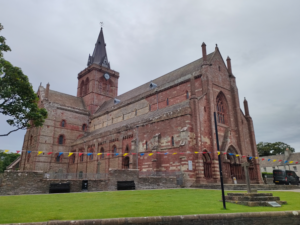
St Magnus Cathedral
The race started on Broad street directly outside the Town Hall in front of the Cathedral where the Annual Ba’ game (vicious no rules street rugby basically) starts on New Years day and Christmas day with the “Uppies” and “Doonies” pushing either up the street or down the street to their respective “goals” (in the sea for the Doonies or up against a wall called Mackinson’s Corner for the Uppies ).
A field of around 50 runners all set of in the lovely sunshine and with a very fast pace being set by some of the relay runners (3 in a relay team).
First mile was flat through the streets of Kirkwall (a rarity on this route) and I kept up with my school mate but with a pace of 8 minutes being set as we passed the first mile marker it was time to say “cheerio- see you at the finish”, and with the road beginning to head uphill I reduced my pace to a more manageable time (my mate kept going and posted sub 8 minute miles for the next 11 miles and eventually finished with a new marathon PB and 4th overall)
From Kirkwall the route heads over to the “old” Kirkwall to Finstown road and some nice views of Scapa Flow appear looking south. The natural harbour of Scapa Flow was where the British Home Fleet had its naval base during the two World Wars and also where the interned German High Fleet scuttled 52 of their ships in 1919. Most were salvaged between the wars but there still remain several of the German wrecks in the Flow which has become a divers paradise. Also sunk in the Flow by U-boat in 1939 was HMS Royal Oak with the loss of almost all her crew and which is now classified as a war grave so no diving permitted. A positive side to the sinking was the order for the construction of a series of permanent barriers to link some of the south isles to prevent further U-boat attacks and these “Churchill Barriers” now have roads on them allowing traffic to flow to the islands. Also just over the first barrier is the beautiful “Italian Chapel” built out of 2 Nissen huts by the Italian POW’s who worked on the barrier construction.
Heading on the long up hill out of Kirkwall I fell in with a couple of other runners and we kept together for the next few miles but the route is up and down all the way to the village of Finstown where I grew up. Coming down off Wideford hill the road takes a sharp turn at BridgeEnd and is thankfully flat again for half a mile before a short sharp kicker of a brae and the views of the Bay of Firth with the village coming into sight.
There was an old guy (Bert) who lived in what is now a ruined cottage at BridgeEnd and Bert O’ BridgeEnd was (in)famous for having a copy of his own Death Certificate. During the war he had escaped from the Japanese and had been given up for dead so the govt issued his death certificate but several months later he emerged from the jungle and was re-patriated.
With the hills behind the village appearing you can see the ancient monument of the Cuween hill chambered cairn up on the hillside, or also known as Tomb of the Dogs due to the number of dog bones found with the other remains in the chamber and up on the skyline above are a group of about a dozen stone cairns. Originally there was only 1 cairn on the top of the hill but it blew down in a storm several years ago so in my youth I rebuilt a new one and over the years since then a few more have been added to the skyline.
Arriving into Finstown it was great to get cheered on by my folks and few of the neighbours who had gathered at the road side as I passed our house. Another rare mile of flat through the village passing the graveyard with its war memorial which was unveiled by my great grannie after WWI as she had lost the most family members from the parish and the route then headed out of the village and towards my old primary school, crossing the brig before the school that my grandad had wired with explosives during the war in case it needed to be demolished.

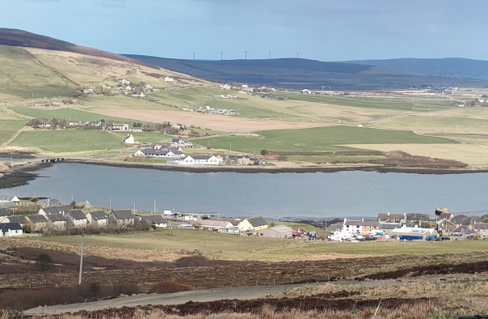
Finstown, Orkney
The Firth school at mile 8 is the first handover point for those doing the relay and from there it was a long drag up hill through the next village (Norseman) and then a steeper hill round the headland before dropping down into Evie. From the headland there are good views over to the isles of Gairsay, Wyre, Rousay and magical Eynhallow (magical as superstition would have it that it could disappear). From my secondary school days there lived a couple of boys on Gairsay and their travel to school usually started and ended with them kayaking to and from the island each day (very strong guys).
Although the route so far had a lot of up and down I knew that the route from Evie onwards was the toughest section of the course. The Evie school at around 15 mile was also the second handover point for those doing the relay.
I was well up on my predicted time of 4:20 so it was a good motivation factor to know that I had enough time in reserve if I did start to badly slow down and also that if anyone passed me from here onwards they were probably a relay runner and not just me slowing down. I was even starting to think about maybe managing a sub 4 hour race but it was going to be close.
On the first long hill up out of Evie I could see someone had started walking towards the top of the climb and myself and the guy in front of me were catching her, he passed her just before the top and just as I was about to pull along side and offer some words of encouragement she managed to start running again and set off downhill at a faster pace than I was prepared to go at and she did eventually finish a few minutes in front me.
After a few more ups and down there was a nice longish downhill section to the Swanney Brewery. They make a great selection of beers and it was very tempting just to nip in past for a few minutes for a tasting, however that would ruin any hope of a sub 4 hour time. This was also the 6th water station at mile 22, so I had my labelled water bottle waiting for me but as I still had about a quarter of my running bottle left I decided to not bother taking on another bottle. There was however a Tupperware container with some Jelly Babies so I took advantage of that to save the last of my own till further on in the last few miles. However big mistake, these were certainly not Bertie Bassett Jelly babies and they tasted disgusting. After a brief coughing fit to spit them out, managed to carry on up the hill beyond the brewery and thankfully past the last of the up-hills.
By this point I was starting to think that sub 4 hours was definitely do-able.
Once up and over the hill the tidal island of the Broch of Birsay comes into sight and further to the left at the top of the cliffs stands the 48ft high tower of the Kitchener Memorial.
This was built in 1926 to commemorate the loss of Lord Kitchener of Khartoum and the officers and crew onboard the HMS Hampshire in 1916 which was sunk in stormy weather by a mine laid off Marwick Head. The ship was on a secret mission to take Kitchener to Russia to persuade the Tsar to boost his war effort. Only 12 out of the whole ship survived.
At last a nice straight run of downhill to the shoreline, half way down the hill I was passed by someone who looked to be sprinting down the hill (a third legger from a relay team I hoped) and then a sharp left turn to go past the Earl’s Palace which was built by the Earl of Orkney who was the illegitimate son of James V in the 16th Century and also for those that have studied Scots law, the case law of “Force & Fear” originated with the case of “Vinfra Vs the Earl of Orkney” where poor frightened Vinfra was forced to sign a contract in the Palace but only after the Earl threatened him with his “Whinger” (dagger).
Just as I thought there was no more up hill, the last mile from the Palace goes slightly up from the coastline until the road runs out and then across a grassy track to rejoin the road leading to the finish line at the community centre. By this time, I knew I was going to be Sub 4 hours unless I tripped and fell. I was unfortunately passed by a non-relay runner going up the grassy track and didn’t have the energy to chase them down before the line although I did close the gap between us in the last 200 yards.
Crossed the finish line just under 3 hours 58 minutes so very happy with the result. Turns out I also finished 4th in my age category. If the race had been a couple of months earlier the guy who finished first would have been in a younger age group and I would have been 3rd and got one of the lovely trophies crafted in the shape of the Whale Bone Cross that used to stand on the coastline of Birsay before it blew down in yet another storm only a few years ago. My mate from school finished 2nd in our age group.
After receiving my goodie bag (including some Swanney Beer) plus medal for finishing the race and a bit of recovery time it was into the community centre for a mince roll (yes-mince served inside a roll and it is very common in Orkney) and a drink then wait for the presentations.

Ralph and friends at the finish
As a great example of how well organised the race was, the medal presentations were started with the caveat that there was still one last runner out on the route and the presentations would be halted when the runner was approaching the 26 mile marker so that people could go back to the finish line and the last runner would get the same experience as everyone else for crossing the line with a crowd watching. In fact I’m sure she got a bigger cheer than the winner would have got.
The event was really well organised, plenty of marshals out on the course, well signposted and food and drink available after the race.
I can certainly recommend this race to anyone wanting to run it. Just don’t expect a super fast marathon time and don’t rely on getting good weather. I was very lucky.
Would I run another marathon? – Yes
Would I run St Magnus again? – Probably Yes
Would the weather be as good again? – Almost certainly not but you never know.
Ralph Williams